2007-06-10

Qingdao city


Qingdao, an old port city situated on the Southern coast of Shandong, is a quaint and popular spot for travelers and sun seekers alike.

Qingdao, an old port city situated on the Southern coast of Shandong, is a quaint and popular spot for travelers and sun seekers alike. At first sight the city seems almost a small town, a quick stroll around the railway area, close to the seafront, can be a deceptive image of the city proper, a deception that thankfully tends to stick with most of her visitors. With a total area of 10.645 square km and a total population of 6.95 million (2.27 million in the urban district), Qingdao is in fact one of China's most important economic cities and is the nation's fourth largest port.

Qingdao lies between mountain and sea, a coastal port with clear deep waters and a comfortable climate. The mountains provide a collection of interesting sights, centered around the mystical Laoshan, while the sea provides relaxation, gentle waves, bared rocks, and some golden beaches forming what is probably China's best northern beach resort. The historical culture, variety of religion, civil traditions, village customs, and holiday celebrations all add to Qingdao's rich culture.

Location and Climate

Qingdao is located in the south of Shandong Peninsula, with the Yellow Sea to the east and south, and the mainland to the west and north. Qingdao covers an area of 10,654 square km. Lying in the temperate semi-humid continental climate zone, it is a well-known summer resort. The average summer and winter temperatures are 25¡æand 1.3¡æ respectively.

Administrative Division

The 7 districts of Shinan, Shibei, Sifang, Licang, Chengyang, Huangdao, and Laoshan,
and the 5 county-level cities of Jiaozhou, Jiaonan, Jimo, Pingdu, and Laixi, with a total population of 7.1049 million come under the jurisdiction of Qingdao.

Product Resources

The area has a total of 870 km of coastline and 375 square km of shallows. The main marine
products include salt, shrimp, sea cucumber, abalone, scallops and seaweed. Natural resources such as gold, graphite, marble, granite, diamonds, magnetite, mineral oil, coal, and iron are abundant. The distributing area of hot spring reaches more than 10 hectares.

Tourism Resources

Shilaoren National Holiday Resort, Mount Lao State-level Scenic Area, and Mashan State-level Natural Reserve are located here. The Seaside Scenic Area has beautiful scenery and a variety of well-preserved classical European style structures. The seaside Suplpture Garden and Sculpture Street in the eastern part of the city are now established tourist attractions. There are 2 golf courses and 39 hotels rated above three-stars, which accommodated 15.5144 million visitors in 2001.

Scientific and Technical Personnel

Qingdao is a famous marine science and technology city, boasting 590,000 scientific and technical personnel. There are 24 academicians of the Chinese Academy of Sciences and the Chinese Academy of Engineering working here. The city has advantages in the IT industry, new material technology, biological technology, and agricultural science. There are 58 independent research institutions, 34 national key laboratories, 54 college or university-run research institutes, 80 municipal-level enterprise technological centers, 234 enterprise-run research institutes and 425 hi-tech enterprises located in this area.

Port

Qingdao Port is one of China's major trading ports and one of the top fifteen hundred-million-ton ports in the world. The port consists of docks for containers, ore, petroleum and coal. The annual cargo handling capacity in 2000 exceeded 86 million tons and 2.1 million TEUs.

Airport

There are over 300 flights a week for 42 national and international air routes from Qingdao, including 9 international and regional routes involving 40 flights a week.

Railway

There are freight and passenger trains to many large cities in the North, East, South, Mid South, Northwest and Northeast of China.

Highway

Main highways include the Jinan-Qingdao Expressway, Qingdao-Yantai Expressway, Jiaozhouwan Expressway and the Qingdao-Yinchuan Expressway, which is now under construction. As a vice-provincial-level city, Qingdao ranks first in terms of expressway traffic mileage in China.

Telecommunications

There are 76.48 telephones per hundred citizens in Qingdao. In addition there is a million gate analog and digital mobile telecom network, with a GSM through rate that ranks third in China.

Environmental Protection

The planned control targets for the overall discharge of the 12 main pollutants have been met and standardized discharge has been realized. All the annual average indices of main pollutants in the urban surface water areas and atmosphere meet the relevant standards.

Education

There are 16 colleges and universities, including Qingdao Ocean University, a key university of the Ministry of Education and the only one of its kind in China. Children of foreign business people can study at Qingdao International School and Qingdao Nanyang School.

History&culture of Shandong province

Shandong is one of the birthplaces of the ancient Chinese culture। The Yiyuan ape-man fossil proves there were human beings in the area some 400,000-500,000 years ago.

Culture

Shandong is one of the birthplaces of the ancient Chinese culture. The Yiyuan ape-man fossil proves there were human beings in the area some 400,000-500,000 years ago. The Beixin Culture, Dawenkou Culture and Longshan Culture found in the province prove that between 7,000 to 4,000 years ago, the Dongyi people had changed from a matrilineal to a patrilineal society and even to a class society. Some other historical finds in Shandong include Dawenkou and Longshan pottery characters, the earliest Chinese characters discovered in China, Chengziya Longshan Ancient Town, one of the earliest cities in China, the old Great Wall of the Qi State, the earliest defense works in China, the tombs of Han Dynasty Kings at Luozhuang, one of China's 10 Most Remarkable Archaeological Discoveries in 2000. Besides, Shandong is one of the birthplaces of ceramics and silks.

Hometown of Celebrities

Shandong has always been known as the "hometown of Confucius and Mencius, as well as the land of ceremony and propriety". Throughout history, Shandong has produced many celebrities who have exerted great influence on Chinese culture, and that continues to this day. Confucianism created by Confucius, the great thinker, educator and politician honored as a sage, is pivotal to Chinese culture and still exerts influence around the world. The Art of War written by sun-tzu, a famous ancient strategist in Shandong, is considered as a classic in both military and commercial circles. Besides Confucius and Sun-tzu, who were respectively renowned as the "Sage of Culture" and the "Sage of Strategy", other famous ancient figures from Shandong include Wang Xizhi, the "Sage of Calligraphy", inventor Lu Ban, miracle-making doctor bian Que, strategist Zhuge Liang as well as poets Li Qingzhao and Xin Qiji, and novelist Pu Songling.

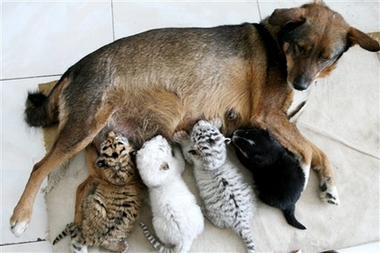
Dog nurses tiger triplets at Jinan zoo


A dog feeds tiger triplets and her own puppy, right, at the Paomaling Zoo in Jinan, capital of east China's Shandong Province, Wednesday, May 16, 2007.
The cubs, whom officials at the Jinan Paomaling Wild Animal World in Shandong province are so far just calling "One," "Two" and "Three," have been nursed by a dog since they were rejected by their tiger mother shortly after birth, said Paomaling manager Chen Yucai.

The trio's adoptive mother, a mixed breed farm dog called "Huani," is expected to nurse them for about a month or until their appetites outpace her supply, Chen said.

Chen said it is common for Chinese zoos to use surrogate dog mothers to nurse rejected tiger cubs and that Huani has nursed tigers before.

In the past, Paomaling put dog urine on their rejected cub's fur to make the surrogate think she was nursing one of her own puppies but the zoo didn't bother with Huani because she seemed not to mind nursing the tigers, he said.

"The family is getting along well and seems to enjoy each other," Chen said.

Heavy floods hit S. China town


Roads and residential houses are submerged after heavy floods hit Yaoan Town, south China's Guangdong Province on Thursday. Sustained rainstorm is blamed for the floods, which disrupted traffic and inundated farmland, wreaking a havoc on local people's daily life. Rescue work is underway.

World models feel Chinese culture


(China News Service Photo)

Candidates from 40 countries gathered in Hutang of Changzhou, Jiangsu Province for the World Super Model Contest on June 7. They experienced Chinese culture in this ancient Chinese town, where the World Super Model Contest 2007 will be kicked off.


Chinese communications giant to increase investment in Russia


ST. PETERSBURG, Russia, June 9 (Xinhua) -- China's leading telecom provider, Huawei Technologies Co. Ltd., will increase investment in Russia, senior management officials said here on Saturday.

"We will increase investment in Russia, enhancing local research and development, as well as providing better service for Russian clients and consumers," said Sun Yafang, chairwoman of board of directors at a ceremony marking the company's 10th anniversary of operations in Russia.

She did not give further details, only pledging that Huawei will insist on the localization of the industry.

Huawei has set up jointly-funded factories and labs in Russia with a total sales volume of 1.2 billion U.S. dollars till 2006 and some 1,000 local employees.

Chinese Vice Premier Wu Yi and Russian Deputy Prime Minister Alexander Zhukov were present at the occasion.

"Chinese companies, typically Huawei, have contributed to the Sino-Russia cooperation in the telecommunication sector by providing quality products, solutions and back-up service," said Xi Guohua, Chinese vice minister of Information Industry.

Huawei has established more than 100 branches worldwide, including research and development centers in Russia. It has more than 1 billion customers and top telecommunications service providers as clients in more than 100 countries.

The company's annual sales income totaled 11 billion U.S. dollars last year, of which, some 70 percent were from the international market.